"Visions of Spain…in Music!" for Yakima Herald Explore
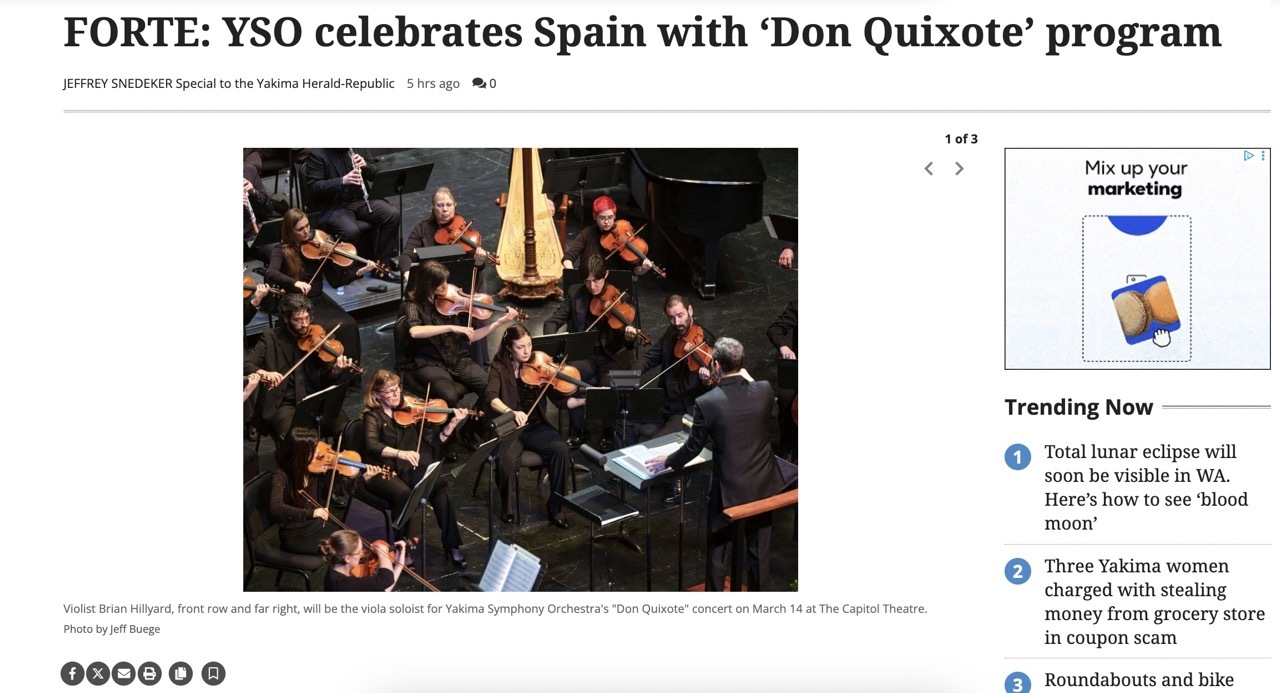

Spain’s artistic heritage is the theme of the Yakima Symphony Orchestra’s March 14 “Don Quixote” program, with three works inspired by the country’s passionate, vibrant musical culture.
Miguel de Cervantes’s famous novel Don Quixote was originally published in two parts in 1605 and 1615. Many feel it is the greatest work of fiction ever written. It describes the adventures of a lower-class nobleman from the city of La Mancha named Alonso Quijano who reads so many chivalric romances that he loses his mind and takes it upon himself to revive chivalry in his country, under the name Don Quixote de la Mancha. He recruits a squire, Sancho Panza, who balances the Don’s lofty discourse with real-world perspectives and humor.
Richard Strauss composed Don Quixote in 1897. Subtitled“Fantastic Variations on a Theme of Knightly Character,” each variation represents a different adventure from Cervantes’s stories. The composer took a further descriptive step, using a solo cello to represent Don Quixote (played by guest soloist Mark Kosower, Principal Cello of the Cleveland Orchestra), and a combination of solo viola, tenor tuba, and bass clarinet to depict Sancho Panza. The adventures are strung together continuously, and Strauss included brief written statements in the score to help performers and audiences understand the specific adventures the two characters experience.
In Strauss’s story, Don Quixote embarks on his chivalric crusade, battling with windmills, sheep, monks, and other folks they encounter, pursuing his vision of the perfect woman, enjoying a fantasy of flying on a wooden horse, and discussing matters of deep importance with his squire. In the end, Strauss gives the knight-errant his final rest with dignity, though one can also hear sadness in the loss of a friend and the end of an era. Strauss’s Don Quixote pushes the technical and musical limits of the soloists and the orchestra, but when one knows the story, the depth of expression is amazing.
Johann Strauss, Jr.’s Spanish March, presented in keeping with the theme of our 2025–2026 season, was composed in 1888 and dedicated to the regent of Spain at the time, María Cristina. After a planned concert tour through Spain was cancelled, Strauss sent the piece as his musical greetings to Madrid, for which Strauss received the Grand Cross of the Order of Isabella. Spanish musical flavorings are heard throughout, with brassy fanfares, folk music elements, and even the addition of castanets!
The final work on the March program is a suite of ballet music by Manuel de Falla, a central figure of 20th-century Spanish music. His The Three-Cornered Hat is a ballet based on a novella by Pedro Antonio de Alarcón. The story is a familiar one: a magistrate (who wears a symbolic three-cornered hat) is infatuated with a miller’s wife. The miller and his wife try to play a trick on him, but it backfires and the miller is arrested. After a series of escapes, fights, and attempted arrests, all is exposed, and the miller and his friends exact peasant justice by tossing the magistrate into the air using a blanket.
The influence of Andalusian folk styles, including some flamenco, is obvious, and Falla uses wonderful splashes of color to create not only a vibrant backdrop for the action but music that stimulates the imagination to follow the storyline.
Tickets at YSOmusic.org. For more information, call 509.248.1414.
—Dr. Jeffrey Snedeker
Jeffrey Snedeker has been Principal Horn of the Yakima Symphony Orchestra since 1992. He is also a Board of Trustees Distinguished University Professor at Central Washington University where he teaches horn and music history.